Dog Ramp for Bed: How to Pick the Right Height, Incline, and Size for a Senior Dog (2026 Guide)
Aging Paws Guide is reader-supported: as an Amazon Associate we earn from qualifying purchases made through links on this page, at no extra cost to you.
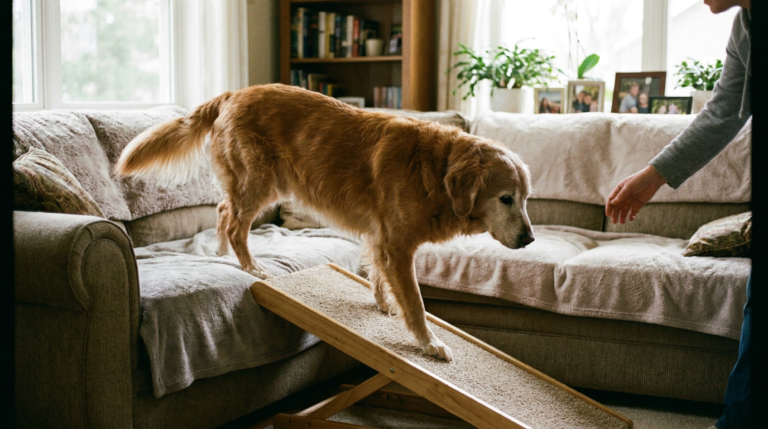
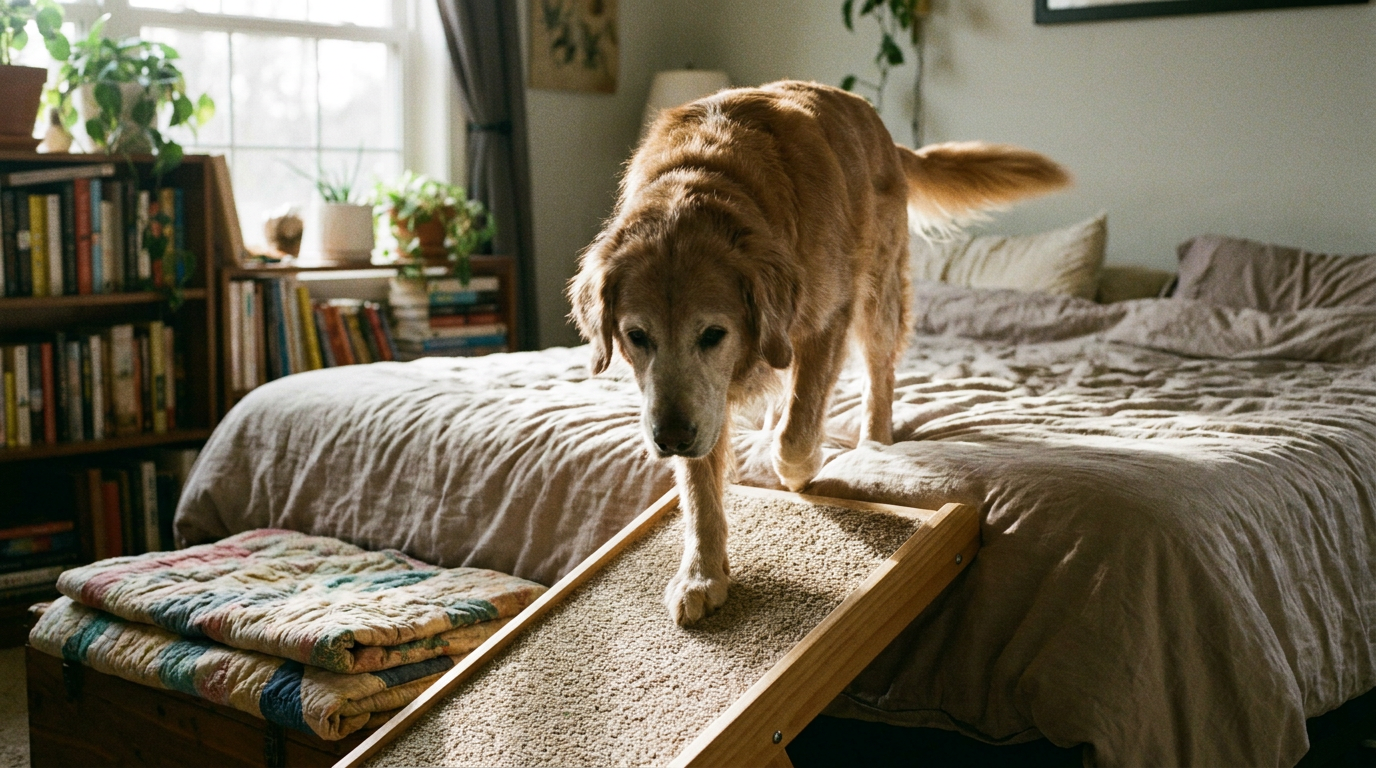
If your older dog has started pausing at the edge of the bed — gathering themselves before a jump, or looking back at you instead of jumping at all — that hesitation is information. Jumping up to a bed, and especially jumping down from one, sends a hard jolt through aging shoulders, hips, and spine. A ramp removes the jolt. But a ramp only helps if your dog will actually use it, and the single most common reason a dog refuses a ramp is that it is too steep.
That is the thing most buyers get wrong, and it matters more for a bed than almost anywhere else in the house. Here is how to choose one that works.
Why a bed ramp is harder to get right than a couch ramp
A couch sits around 16–18 inches off the floor. A bed is usually 24 to 35 inches — sometimes taller once you count a thick mattress and a frame. That extra height changes everything about ramp choice, because a ramp’s steepness is a function of how high it has to climb versus how long it is. The taller the bed, the longer the ramp has to be to keep the slope gentle.
This is why a ramp that worked fine against the couch can fail completely at the bed: same ramp, taller target, steeper climb. If you have already set up a ramp for your couch, do not assume the same dimensions carry over.
What incline is safe for a dog ramp?
The practical safe range for senior dogs is 18 to 25 degrees. Veterinary rehab guidance lands here consistently:
- 18–20° for small dogs, or any dog with significant weakness, arthritis, or hind-end instability.
- 22–25° for dogs who are still reasonably mobile and just need to stop jumping.
- Above ~30°, most older dogs simply will not use the ramp reliably — and if they do, the strain on the hind legs and spine starts to undercut the whole point.
If you take one number away, make it this: most ramps sold are too steep for a tall bed. Manufacturers design to a footprint that fits a bedroom, not to the angle your dog’s joints need. That tradeoff is yours to catch, not theirs.
How long does the ramp need to be for your bed?
You can work this out in about thirty seconds.
- Measure the rise — floor to the top of your mattress. Say it is 28 inches.
- Pick your target angle — 20° for a wobbly senior.
- Divide the rise by the sine of that angle. Sin(20°) ≈ 0.34. So 28 ÷ 0.34 ≈ 82 inches — nearly 7 feet of ramp.
That number surprises people, and it is the most useful thing on this page. A gentle ramp to a 28-inch bed needs to span most of 7 feet of floor. If you only have room for a 4-foot ramp against a 28-inch bed, you are mathematically forced into a steep angle (around 35°) that many senior dogs will refuse. Better to know that before you buy than after.
Quick reference, targeting a ~20° slope:
- Bed height 24″ → ramp ≈ 70″ (about 6 ft)
- Bed height 28″ → ramp ≈ 82″ (about 7 ft)
- Bed height 32″ → ramp ≈ 94″ (about 8 ft)
If those lengths will not fit your room, that is a real constraint — see the ramp-vs-stairs section below.
Ramp or stairs for a tall bed?
For a bed specifically, a ramp is usually the better choice, with one big caveat about space.
A ramp is better when: your dog has a long back (Dachshunds, Corgis, Basset Hounds) or any spinal issue, arthritis, or hind-leg weakness. The smooth walking motion avoids the repeated step-up-step-down impact that stairs demand, and that impact is exactly what an arthritic or disc-prone dog should avoid.
Stairs are reasonable when: your dog is small, still fairly agile, and just needs a boost — and your floor space is tight. Stairs climb steeply, so they take up only 15–24 inches of floor versus the 6–8 feet a gentle bed ramp needs. For a tall bed in a small room, that footprint difference is sometimes the deciding factor. (We will cover stairs in depth in a dedicated guide.)
For most genuinely arthritic or wobbly seniors, though, the ramp wins on joints — if you can fit it.
What else actually matters when choosing
Once the length and angle are right, these are the features that separate a ramp your dog trusts from one they avoid:
- Traction. This is non-negotiable. A smooth or under-gripped surface causes slips, and one bad slip can scare a senior dog off the ramp permanently. Look for a high-grip carpeted or rubberized surface, not slick plastic.
- Width and side rails. Narrow ramps make dogs nervous, and a nervous senior will not commit. Roughly 11–12 inches of width suits toy and small dogs; 22–24 inches suits medium breeds. Side rails help anxious or visually impaired dogs stay centered.
- Stability. Any wobble teaches your dog the ramp is not safe. A wide base and enough weight to stay planted matter more than they sound.
- Weight capacity. Confirm it comfortably exceeds your dog’s weight. Many bed-height ramps are rated to 150–200 lbs; match it to your dog with margin.
- A top landing or platform. For tall beds, a small flat platform where the ramp meets the mattress gives the dog a stable place to step on and off, instead of an awkward transition at the steepest point.
- Foldability is convenient for storage, but do not let it override length or stability. A ramp that folds small enough to tuck away is often a ramp too short to be gentle. Pick the right slope first; treat folding as a bonus.
Helping a hesitant dog actually use the ramp
Buying the ramp is half the job. Senior dogs are wary of new objects, and a ramp that goes unused is wasted money.
Start with the ramp flat or at a very shallow angle, reward your dog for walking across it on the ground, then gradually raise it to the bed over several days. Keep treats at the top. Never lift and place your dog on the ramp — let them choose it. If your dog has the strength and joint comfort to use it, patience usually gets there within a week.
If your dog cannot manage even a gentle, well-introduced ramp — refusing despite low angle and good traction — that can signal the underlying mobility problem needs attention beyond gear. Pain, sudden weakness, or a dragging rear leg is a reason to call your vet, not to buy a different ramp. Supporting aging joints is also where joint supplements and glucosamine come in — a ramp manages the symptom, but the joints themselves often need their own support.
Bottom line
For a senior dog and a tall bed: measure your bed height, target an 18–22° slope, and use the rise-divided-by-sine math to get the length you actually need — usually 6 to 8 feet, longer than most people expect. Prioritize traction and stability over how small it folds. And introduce it slowly. Get those right and a ramp gives an aging dog back something that matters more than convenience: the ability to reach their favorite spot, and yours, without pain or risk.