
Dog Ramp for Couch: Best Picks for Senior & Small Dogs (2026 Guide)
Aging Paws Guide is reader-supported: as an Amazon Associate we earn from qualifying purchases made through links on this page, at no extra cost to you.
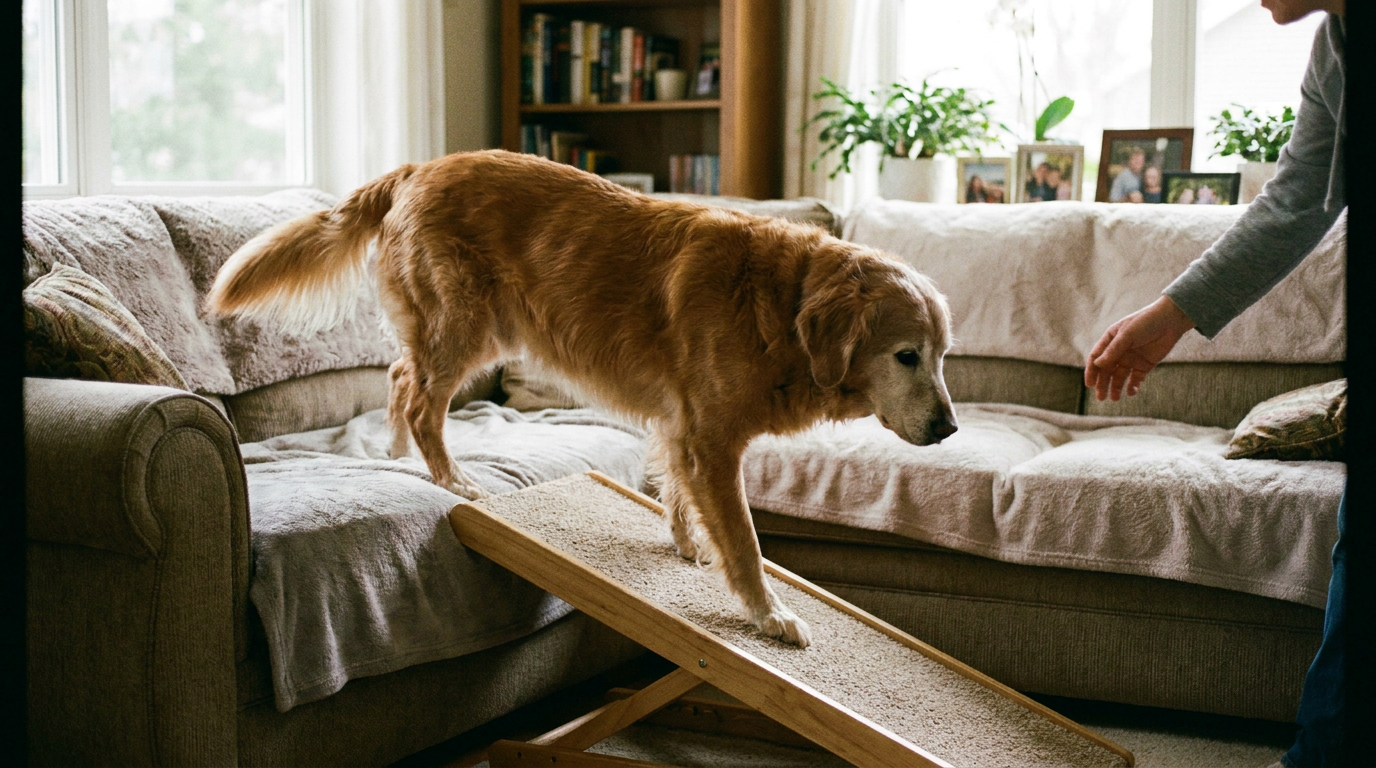
If your dog has started hesitating before jumping onto the couch — or landing hard and stiff when they come down — a ramp is one of the simplest ways to protect their joints. For senior dogs, dogs recovering from surgery, and small breeds prone to back problems, a dog ramp for the couch removes the repeated high-impact jumping that wears down hips, elbows, and spines over time.
This guide covers whether you actually need one, how to choose the right ramp for your couch height and your dog’s size, and the alternatives worth considering first.
Do vets recommend dog ramps?
Yes — veterinarians routinely recommend ramps for dogs at risk of joint or spinal injury. The reasoning is mechanical: every time a dog jumps down from a couch, the front legs and shoulders absorb a force several times the dog’s body weight. In a young, healthy dog that’s not a problem. In a senior dog with arthritis, a dog with a history of cruciate ligament injury, or a long-backed breed like a Dachshund or Corgi, that repeated impact accelerates damage and pain.
Ramps are especially recommended for dogs with arthritis or hip dysplasia, dogs recovering from orthopedic surgery (where a vet may explicitly forbid jumping), breeds prone to intervertebral disc disease, and any dog showing early mobility decline — hesitating before jumping, taking the couch in two stages, or no longer attempting it at all.
If your dog is already showing stiffness or reluctance, it’s worth pairing a ramp with a broader joint-support plan. See our guides on senior dog supplements and glucosamine for dogs.
Ramp or stairs: which does your dog actually need?
This is the first real decision, and it matters more than brand.
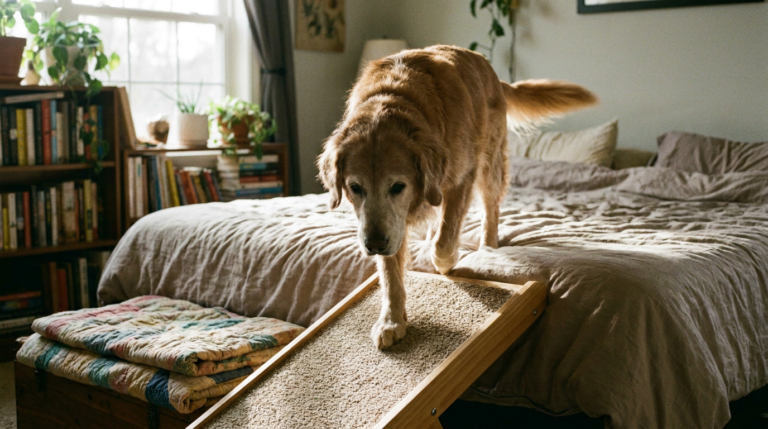
A ramp is a continuous inclined surface. The dog walks up and down it the way they’d walk up a hill. Because there’s no stepping or hopping involved, a ramp keeps the spine and joints in a steady, low-impact position the whole way. This makes ramps the better choice for dogs with significant arthritis, hip or knee problems, post-surgical restrictions, or any back condition.
Stairs are a set of steps. They take up less floor space and many small dogs use them happily, but each step still involves a small hop up or down — meaning some impact remains. Stairs suit small, relatively healthy dogs in tight spaces more than they suit large or seriously arthritic dogs.
If your dog’s mobility is the reason you’re shopping, lean ramp. If it’s mostly about convenience for a small, healthy dog and you’re short on space, stairs are a reasonable call. (We cover steps in detail in our dog stairs guide — coming soon.)
How to choose a dog ramp for your couch
Five things determine whether a ramp actually gets used or ends up in a closet.
Height match. Measure from the floor to the top of your couch cushion where your dog will step off. Most couches land between 14 and 22 inches. The ramp needs to reach that height at a gentle angle — which is why adjustable-height ramps are popular for couches, since seat height varies a lot between sofas.
Incline angle. This is the part people skip, and it’s the most important. A ramp that’s too steep just becomes stairs without steps — the dog refuses it. The longer the ramp for a given height, the gentler the slope. For senior and arthritic dogs, prioritize a longer, lower-angle ramp even though it takes more floor space. A good rule of thumb is an incline no steeper than about 18–25 degrees for older dogs.
Weight capacity. Check the rated capacity against your dog’s weight with a clear margin. This matters most for large and giant breeds, where many couch ramps are underbuilt.
Surface grip. The ramp surface must be non-slip — a carpeted or high-traction rubberized surface. A slick ramp is worse than no ramp, because a slip will teach the dog to distrust it permanently. Side rails add a margin of safety for dogs with poor balance or vision loss.
Foldability and footprint. Couch ramps live in your living room, so most people want one that folds flat or is light enough to move for vacuuming. Telescoping and folding designs trade a little stability for a lot of convenience.
What is the best dog ramp for couch use?
There’s no single “best” ramp — the right one depends on your dog’s size and your couch. But the categories sort out cleanly:
- Folding ramps — a flat panel that folds in half. Light, affordable, easy to store. Best for small-to-medium dogs and lower couches.
- Telescoping ramps — extend and retract to set length. The extra length lets you dial in a gentle incline, which makes them strong for senior and arthritic dogs. Heavier and pricier.
- Adjustable-height foam/bolster ramps — upholstered ramps with adjustable feet, designed to blend into living-room furniture. Often the most couch-specific option, with height settings that match common sofa seats and optional side rails.
- Large-breed reinforced ramps — built with higher weight capacities and wider walking surfaces for big dogs, where standard couch ramps flex or feel unstable.
Match the category to your dog first (size, joint condition, balance), then pick within it on height range, incline, and grip. A small healthy dog and a 90-pound arthritic Lab need very different ramps.
What can you use instead of a dog ramp?
If you’re not ready to buy, there are workable stopgaps — with caveats.
A firm ottoman or sturdy storage cube placed beside the couch creates a single intermediate step, breaking one big jump into two smaller ones. It’s better than a full jump but still involves impact, and it must be stable and non-slip.
A pet stairs set you already own can serve, keeping in mind the ramp-vs-stairs tradeoff above.
A folded thick foam pad or wedge cushion can form a low ramp for very small dogs, though most aren’t long enough to give a gentle slope or stable enough for repeated use.
These bridge the gap, but for a dog with real joint or back issues, a purpose-built ramp with the right incline and a non-slip surface is the safer long-term answer. The cost of a ramp is small next to the cost of treating an injury the jumping caused.
Helping your dog actually use the ramp
Even the best ramp does nothing if the dog won’t step on it. Introduce it flat on the floor first, let the dog walk across it for treats, then gradually raise it to couch height over a few days. Reward every successful trip at first. Keep the ramp in the same spot so it becomes part of the routine, and never force a hesitant dog — a single scary slip can set you back weeks.
For dogs whose reluctance comes from pain rather than unfamiliarity, address the underlying joint issue alongside the ramp. Persistent stiffness, difficulty rising, or sudden refusal to move are worth a vet visit. Our guide on senior dog supplements covers joint-support options to discuss with your vet.
The bottom line
A dog ramp for the couch is a small, low-effort change that pays off in protected joints and a dog who can stay close to you without risking injury. Prioritize a gentle incline and a non-slip surface over everything else, match the height to your specific couch, and size the weight capacity to your dog with margin to spare. For senior, arthritic, or post-surgical dogs, a ramp isn’t a luxury — it’s preventive care.
One Comment
Comments are closed.