Orthopedic Memory Foam Dog Bed: What Actually Helps Senior Dogs
Disclosure
This article contains affiliate links; we may earn a small commission if you purchase through them, at no extra cost to you.
Watching a dog you’ve had for a decade struggle to get up from the floor is one of the harder parts of senior pet ownership. The hesitation, the grunt, the slow unfolding of stiff limbs — it’s not just age. It’s often pressure and lack of support compounding joint pain that’s already there. An orthopedic memory foam dog bed is one of the few practical interventions that can genuinely help, but the phrase gets applied loosely enough that it’s worth understanding what’s actually inside these beds and what separates a useful one from a rebranded nap mat.
What “Orthopedic” Actually Means in a Dog Bed
The word orthopedic has no regulated definition in pet products. Any manufacturer can print it on a label. What it’s supposed to mean — and what you should verify — is that the bed uses high-density foam designed to distribute body weight evenly rather than letting pressure concentrate at bony points like hips, shoulders, and elbows.
Memory foam (viscoelastic foam) is the material that makes a meaningful difference. It responds to body heat and weight, contouring to the dog’s shape instead of pushing back uniformly. For a senior dog with arthritis or hip dysplasia, this matters. Standard polyester fiberfill compresses under weight and offers almost no pressure relief; it also flattens permanently within months. Low-density foam does the same.
The functional measure is foam density, expressed in pounds per cubic foot. Beds marketed for large or arthritic dogs generally use foam in the range of 3 to 5 lb/ft³. Below that range, you’re essentially buying a costume — it looks like an orthopedic bed but performs like a cheap cushion.
Why Joint Support Matters More as Dogs Age
Canine joints don’t heal the way younger tissue does. Cartilage thins, synovial fluid decreases, and inflammation becomes chronic. The surface a dog sleeps on affects how much stress those joints absorb over eight to twelve hours of rest.
Hard floors are obviously worse than any padded surface. But even a medium-firmness flat cushion creates pressure points at the hip socket and shoulder when a dog sleeps on their side — which most dogs do. Memory foam reduces those pressure points by conforming. It’s the same reasoning behind pressure-relief mattresses for humans with joint conditions.
Senior dogs also lose muscle mass, which means bony prominences become more pronounced. A Labrador at twelve has far less natural padding over their elbows and hips than the same dog at four. Calluses and pressure sores can develop on hard surfaces. A proper orthopedic memory foam dog bed addresses both comfort and skin integrity — two things that matter more as dogs age.
Foam Construction: What to Actually Look For
Layer Count and Base Thickness
The best orthopedic dog beds use two or more foam layers. The bottom layer is typically the dense supportive base — this is what prevents the dog from sinking all the way to the floor (called “bottoming out”). The top layer is often softer, providing comfort without sacrificing support.
Base foam thickness matters. A 3-inch base sounds substantial but can compress under a 90-pound dog. For large and giant breeds, look for base layers of 4 inches or more. Smaller dogs can do well with 3 inches.
Egg-Crate vs. Solid Foam
Some beds use egg-crate foam (the kind with a textured, wavy surface). This increases airflow and can be softer, which some dogs prefer. The limitation is that egg-crate foam compresses faster and offers less pressure distribution than solid memory foam. It’s often used as the comfort layer rather than the support layer in better-constructed beds.
Waterproofing
Senior dogs often have bladder control changes. A waterproof inner liner between the foam and the cover is not optional — it’s essential. Foam that absorbs urine cannot be adequately cleaned and will harbor bacteria and odor permanently. The liner should be fully encased, not just placed on top.
Sizing: Bigger Is Usually Better
Dogs should be able to fully stretch out without any limb hanging off the edge. Measure your dog from nose to tail base while they’re sleeping in their natural position. Add at least 6 to 8 inches to that measurement. Most people underestimate how much space their dog actually uses.
For senior dogs with orthopedic issues, being able to roll to a different position without repositioning themselves on the bed reduces middle-of-the-night discomfort. A bed that’s technically big enough becomes functionally too small for a dog who shifts a lot due to joint pain.
Entry Height and Getting In and Out
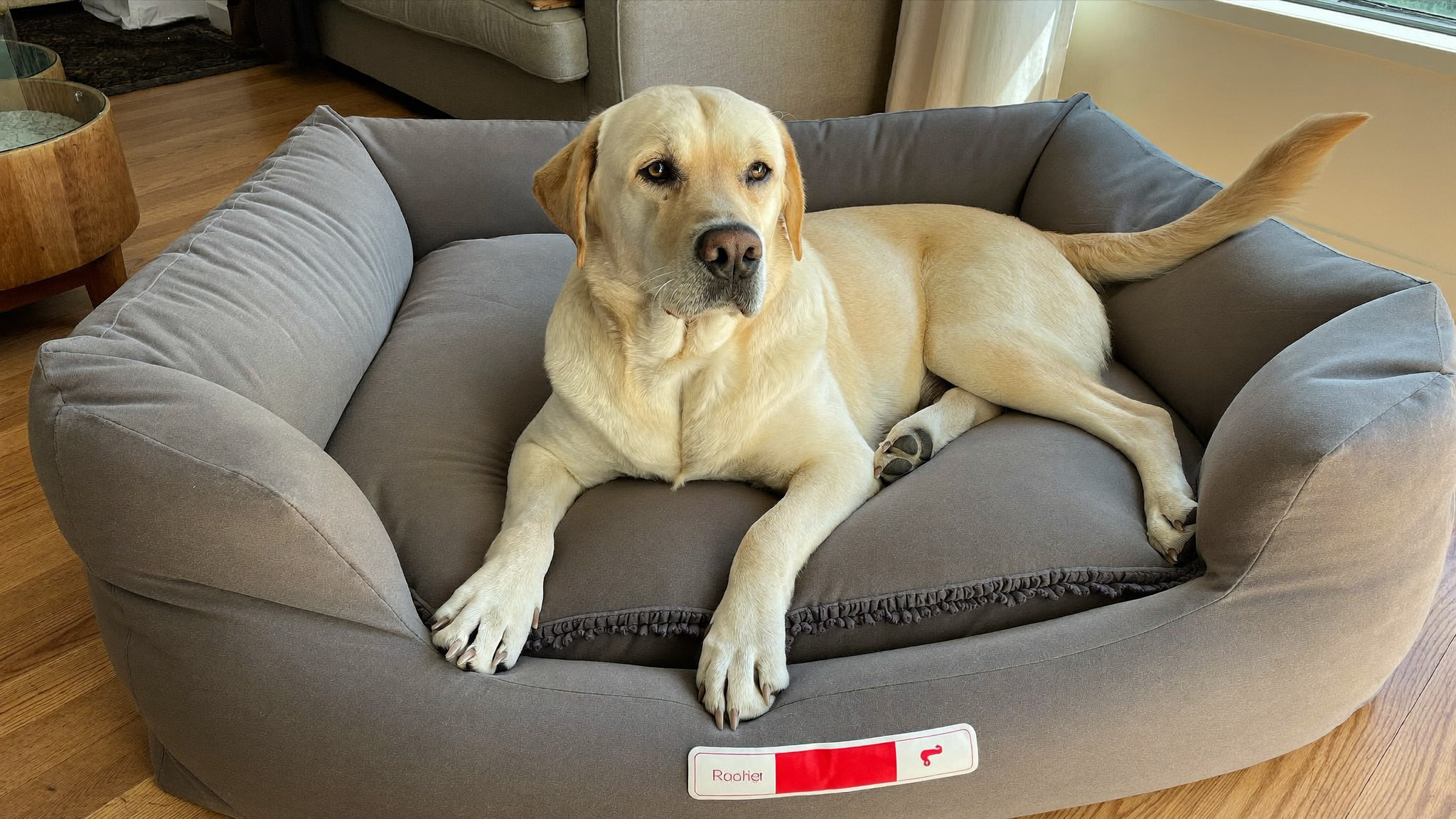
This is the detail most often overlooked. A thick, high-quality orthopedic memory foam dog bed that requires a dog to step over a 6-inch bolster wall to enter is counterproductive for a dog with hip dysplasia or severe arthritis. The entry point matters.
Some designs offer a low or cut-out entry on one side — a step-in style rather than a climb-in. This is worth prioritizing for dogs who are already showing mobility issues. Alternatively, a flat mat-style orthopedic bed with no bolster walls at all removes the entry problem entirely, though some dogs prefer the security of a bolster.
If your dog is at the point where they struggle with steps, a small ramp or step stool positioned next to the bed can also help — especially for dogs used to sleeping on elevated surfaces.
Cover Materials and Cleanability
The cover fabric needs to be machine washable. Full stop. Beds with covers that require hand-washing or dry cleaning are impractical for any dog, let alone a senior dog who may have incontinence, heavier shedding, or skin conditions.
Microfleece and microfiber covers are common and soft, but some trap heat. Dogs with thick coats or dogs in warm climates may overheat on certain materials. Cooling-fabric covers or mesh-panel designs exist specifically for this; they use materials that don’t retain warmth.
For dogs with skin sensitivities or allergies, look for covers marketed as hypoallergenic — meaning they use tightly woven fabrics that resist dust mite penetration. This is particularly relevant for senior dogs, who may have developed environmental allergies over their lifetime.
When a Memory Foam Bed Makes the Most Difference
These beds aren’t magic, and not every senior dog needs one urgently. But they make a particularly clear difference in specific situations:
- Diagnosed arthritis or hip dysplasia — pressure relief directly supports what medication is managing
- Dogs who sleep 16+ hours a day — the longer the rest period, the more surface quality matters
- Dogs who are slow to rise or seem stiff after napping — often a sign of poor pressure distribution during sleep
- Large and giant breeds over age 7 — they have more mass creating more pressure, and joint issues arrive earlier
- Post-surgical recovery — orthopedic beds are often recommended after orthopedic surgeries by vets
If your dog currently sleeps on tile, hardwood, or a thin folded blanket and is showing any of these signs, the upgrade is worth making.
Placement Matters as Much as the Bed
Put the bed somewhere your dog already gravitates toward. That sounds obvious, but people often place beds in “ideal” locations the dog ignores. Draft-free, lower-light spots away from high foot traffic are generally preferred by senior dogs.
For dogs with arthritis, avoid placing the bed near air conditioning vents or exterior walls in cold climates. Cold air directly on joints increases stiffness. A self-warming bed topper — a thin layer of reflective material that retains body heat — can be placed on top of the memory foam for dogs who sleep in cool rooms.
Also consider whether the floor surface around the bed offers traction. A dog stepping off an orthopedic memory foam dog bed onto slick hardwood may slip and injure themselves on the dismount. Non-slip rugs or yoga mat sections around the bed perimeter solve this simply.
The right bed won’t reverse joint disease. But for a dog who’s been sleeping on inadequate surfaces while managing chronic pain, the change can be visible within a few nights — faster rising, more relaxed posture during sleep, less overnight restlessness. That’s worth understanding clearly before you choose one.
See it in action
@chrismikerabe